
Will closed-door diplomacy succeed in stopping the war in Sudan?! – The face of truth – ✍️ Ibrahim Shaqlawi
Last week, the Sudanese scene witnessed a second visit in less than a month by the Egyptian Minister of Foreign Affairs, Dr. Badr Abdel Ati, to the Sudanese administrative capital, Port Sudan, a visit that carries with it Very important political messages in the context of Egypt's regional role. The visit took place in light of the current situation and political escalation in Sudan, and its importance increased in relation to the timing of Egyptian President Abdel Fattah El-Sisi's visit to the Emirates on the second day, which raises questions about Egyptian attempts to repair relations. between Sudan and the Emirates away from the spotlight. It seems that Egypt preferred the route of secret diplomatic communications behind closed doors as a tool to avoid the complications that public initiatives, such as the Turkish initiative, could raise.
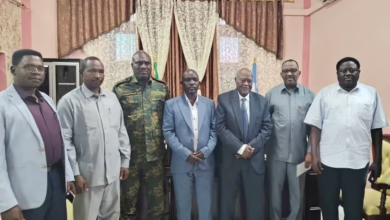
Egypt, which has long maintained strategic relations with Sudan, now appears more willing to play a central role in easing the situation. Abdel Ati's visit included meetings with the Chairman of the Sovereignty Council, Abdel Fattah Al-Burhan, and his deputy, Malik Aqar, as well as with the Sudanese Minister of Foreign Affairs, Ali Al-Sadiq. During these meetings, major issues were discussed, such as reconstruction, water issues and support for Sudanese residing in Egypt. This visit is a continuation of Egypt's growing efforts to support Sudan on the security and political levels. Furthermore, it was agreed to activate joint mechanisms between the Ministries of Foreign Affairs and Irrigation of the two countries, indicating a clear Egyptian desire to strengthen strategic cooperation to face common challenges.
It appears that Cairo has decided to keep the middle canal out of the way, which explains the timing of the Egyptian foreign minister's visit to Port Sudan and then Sissi's visit to Abu Dhabi the next day. These measures demonstrate intense coordination between the Sudanese, Egyptian and Emirati parties to find a formula of understanding that meets Sudan's security and political needs, without putting the United Arab Emirates in a position of direct responsibility.
But the Egyptian decision cannot be read in isolation from regional efforts to end the war in Sudan. In addition to Cairo's support for Sudan's unity and stability, there are indications that Egypt is seeking to bring closer positions between Khartoum and Abu Dhabi. These attempts, which appear secret and unannounced, are perhaps aimed at avoiding political embarrassment for either side, particularly in light of accusations against the UAE of supporting the Rapid Support Militia. Thus, Al-Sisi's visit to the Emirates, the day after that of Abdel-Aty to Port Sudan, seems to confirm the existence of Egyptian-Emirati coordination aimed at calming the Sudanese situation.
This timing reinforces the hypothesis that Egypt preferred to work behind the scenes rather than adopt public initiatives that could be thwarted by public pressure arising from complex scenarios surrounding the end of the war. On the other hand, the Turkish initiative, which called for bringing Sudan and the Emirates to a table of direct dialogue, even if it appears positive, contains symbolic dimensions which can make its acceptance difficult, given that it provides a prior agenda and that some of its provisions are difficult to accept. Abu Dhabi implicitly acknowledges its support for the Rapid Support Militia. Here, the Egyptian role seems more flexible and acceptable, because it tries to reach agreements far from media noise and public initiatives.
It should be noted that Abdel-Ati's visit included presenting the idea of holding an international conference for the reconstruction of Sudan after achieving a ceasefire, with broad international and regional participation. This proposal reflects Cairo's awareness of the importance of providing comprehensive solutions that address the humanitarian and economic repercussions of the war and establish a new phase of stability. It also confirms that reconstruction is one of the fundamental issues on the table of potential negotiations between Sudan and the Emirates, this file therefore has a strategic dimension which is not far from the challenges and opportunities that Cairo is trying to find a specific formula to approach. as Egypt seeks to use its economic and technical expertise to find an approach to this important issue for the Sudanese people and government.
The current Egyptian measures reflect a conscious policy that attempts to balance the local, regional and international dimensions of the war in Sudan. However, the biggest challenge remains Cairo's success in achieving real progress between Khartoum and Abu Dhabi without losing the neutrality that ensures that the different parties accept its role. Does President Abdel Fattah El-Sissi's visit to the Emirates therefore constitute a complementary step? In Abu Dhabi, Al-Sisi and Mohammed bin Zayed discussed numerous regional issues, notably the situation in Sudan. The official statement issued at the end of the visit, which highlights the importance of ending the war and supporting the unity and sovereignty of Sudan, and these are messages that show an Egyptian-UAE rapprochement towards the need to end the war in Sudan, albeit from behind the scenes – behind-the-scenes deals that could include a meeting between Al-Burhan and Ben Zayed, as Sudanese Finance Minister Gabriel Ibrahim recently indicated.
Accordingly, according to what we see in reality, the visit of the Egyptian Foreign Minister and the subsequent visit of President Sissi to the Emirates are part of an Egyptian strategic move aimed at strengthening Egyptian national security by preserving the stability of Sudan . Given the surrounding complexities, Egyptian diplomacy remains facing a real test of its ability to achieve a balance between covert initiatives and stated objectives, while preserving its interests and those of Sudan as an integral part of security and peace. stability of the region. This is reflected in the dynamism of Egyptian policy towards Sudan, in light of the strategy of common interests. This trend makes Cairo a key mediator in a complex equation, in which the country seeks to establish the foundations of security and stability by ending the war and strengthening its regional influence through an approach combining politics, diplomacy and economics.
May you always be well.
Monday January 20, 2025 AD. (email protected)