
Improvement of strategic integration between Egypt and Sudan through the transport portal – something for the fatherland – ✍️ Mr. Salah Gharib
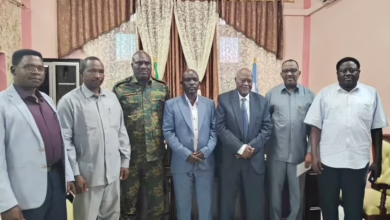
Continuous meetings between Egyptian and Sudanese officials, led by the last meeting between the engine. Kamel Al -wazir, the Minister of Egyptian Transport and the Minister of Urban Development, Sudanese roads and bridges, emphasize the greatest importance in improving joint cooperation in the various areas of transport, as a basic pillar of strategic integration between the two brotherly countries. These efforts are not limited to facilitating the movement of individuals and goods, but also to support economic development and infrastructure, which is positively reflected in the well-being of the two peoples.
The river transport sector is a vital axis in Egyptian-Odan relations, due to its enormous abilities of trade facilitation and the stimulation of the tourism movement. The signing of a joint cooperation protocol between the Egyptian General Transport Authority and the Nile Valley Authority for River Navigation and the Sudanese River Navigation Authority to develop the river sidewalk for the port of Wadi Halfa, with a contractual value of 300 million Egyptian kilos, and with a 69%implementation rate, is a giant stage to reach This objective. This project, in addition to providing and maintaining maritime help with a length of 350 km between Asswan and Wadi Halfa, aims to facilitate the movement of passengers and goods, which improves the commercial flow and reduces flight times. The role played by the joint technical committee for river transport, with its regular meetings, underlines the severity of the continuation of the challenges and to overcome the obstacles. The strategic importance of the navigation corridor between Lake Victoria and the Mediterranean, which places Sudan as a fundamental partner in this ambitious project which improves regional ties, cannot be overlooked.
The desire of political leaders in Sudan to support the urban development projects of distinguished Egyptian companies in the fields of infrastructure, such as Arab entrepreneurs and the general authority for roads and bridges, is proof of confidence in Egyptian experiences and its ability to achieve development. The rehabilitation of “Halfaya” and “Shambat” folds in the state of Khartoum, that Sudan Aspire is a vital project to improve the infrastructure of Khartoum, and Egypt is completely ready to support these efforts. These projects not only help improve the quality of roads and facilitate transport in Sudan, but also opens up new horizons for economic cooperation and the exchange of experiences between the two countries.
Wild ports, like the ports of Arqin and Qastal, are vital doors to improve commercial exchange and cross individuals and humanitarian aid between Egypt and Sudan. The permanent coordination of the general authority for land and dry ports to facilitate transit procedures, and to increase the number of workers in ports to adapt to densities, and to provide administrative services and subsistence services, all the stages necessary to ensure movement flow and reduce crowns. The continuation of the customs authorization procedures represents the cornerstone of the achievement of this objective, because it reduces the time taken to cross goods and individuals, which is positively reflected in the volume of commercial exchange. It is important to underline to discuss new amendments concerning transit costs and their impact on the commercial movement, and to agree on the formation of a joint committee to resolve operational and procedural obstacles, which confirms flexibility and cooperation in challenges.
It is clear that strengthening cooperation in the fields of transport between Egypt and Sudan is the cornerstone of the realization of strategic integration between the two countries. Investing in transport infrastructure, whether the river, land or through ports, is not only an investment in roads and facilities, but rather an investment in the future, opens up new horizons for economic development, improves social and cultural ties and contributes to the stability of the region. While this fruitful cooperation continues, Egypt and Sudan can provide a successful model for regional integration, which will benefit the two fraternal peoples and the whole region.
Given the remarkable progress of cooperation between Egypt and Sudan in the fields of transport, there are already challenges that may appear in the future, which require proactive vision and innovative solutions to ensure the continuity and success of this strategic integration. In my opinion, the most important of these challenges can be summarized in political and security challenges, including political fluctuations or unstable security conditions in one of the two countries or in the surrounding region which can directly affect the continuity of projects, and lead to a slowdown in implementation, or even certain judgments, and can be overcome by establishing flexible conditions of cooperation, while identifying alternatives and alternatives Emergency procedure agreements and alternatives and emergency agreements and emergency alternatives and alternatives and emergency agreements for adaptation of emergency plans in alternatives and alternatives and alternatives and alternatives and alternatives for adaptation, while alternating alternative plans and in accordance situations and activation of preventive diplomacy by strengthening the political and security communication canals and coordination between the two countries to solve any problem emerging before exacerbating them in addition to securing the infrastructure by establishing complete insurance plans for vital projects, in particular in border or distant areas, to ensure their continuity in the light of any disturbance.
Financial and economic challenges and the need for enormous investments to develop and expand transport networks, and countries can find it difficult to attract investors, in addition to coordinating financial policies, exchange experiences in budget management and directing spending on maximum priority projects.
Logistical and Operational Challenges, Despite the efforts made, bureaucratic or procedural obstacles may appear in the border crossings, a shortage of qualified human frames, or challenges related to the maintenance of Equipment and infrastructure, can be overcome by unifying and simplifying customs and editor Implement The One -Winding System and Unify the Documents Required to Accelerate The Transit Process, Invest in Training and Qualification With Construction The Capabilities of Human Frameworks in the fields of port management, logistical operation, equipment maintenance and modern technologies application using intelligent traffic management systems, The effectiveness of operations, in addition to periodic and preventive maintenance by establishing strict maintenance tables for infrastructure and equipment to ensure their preparation and reduce diseases.
Environmental challenges and climate change such as high temperatures, torrents or dehydration can affect transportation infrastructure (such as river roads and bridges), and hinders navigation movements, and can be overcome by designing climate change infrastructure using construction materials and technologies that support the start of the weather. environmental by conducting evaluations for projects before starting studies on environmental impact by conducting assessments included before any project for a project for the impact of conductivity by driving the evaluations included before any project for an environmental impact by conducting the evaluations included in terms of projects before any project for a project of studies on the old Actoursalles hectoral studies by conducting guarantee its sustainability, by developing early alert systems to deal with extremist air phenomena and avoid their impact on transport.
Technological challenges. The fact of not keeping the pace of technological developments in the field of transport can lead to a drop in the competitiveness of the two countries, or the lack of extreme profits from the available opportunities. It can be overcome by adopting innovation, technology and investments in research and development, by encouraging the use of modern technologies in all aspects of the transport sector (such as intelligent transport, digital logistics), the transfer of knowledge and experiences by facilitating the exchange of technological experiences between the two countries and by organizing specialized workshops and training programs.
Drings linked to the conscience and participation of society, part of the community may not carry out the long -term advantages of integration projects into transport, which can affect popular support for these projects, and can be overcome by complete awareness campaigns, and emphasize the positive impact of these projects on the life of citizens, in terms of possibilities of employment, trade facilitation, improvement of the standard meet their needs and take into account their interests.
In conclusion, the treatment of these challenges requires a complete and multiple approach, depending on continuous coordination, flexibility in decision -making and joint commitment to strategic vision to achieve integration. The power of Egyptian-Oudanese relations and the clear political will of cooperation provide a solid basis to overcome future obstacles.