
The new airport sets us up – the face of the truth – ✍️ Ibrahim Shaqlawi

Airports are one of the main pillars of the infrastructure system of modern countries, as transit points for travelers, and it reflects the country’s sovereignty and the level of development that its inhabitants experience, as well as advanced economic centers and direct engines of the national development wheel. In our country, the question of airports must be raised in the light of the exceptional circumstances that we are going through, taking into account the effects of the war on infrastructure.
The reality of Sudanese airports today reflects a fundamental element of the state crisis, because these installations are witnessing a terrible deterioration in the level of services, equipment and management, which loses any regional competitive capacity or even a professional capacity to carry out basic tasks. On the other hand, the regional experiences of countries suffering from similar crises have provided successful models in the conversion of the aviation sector and airports into economic and effective investment, as is the case in Rwanda, Ethiopia and Kenya.
In this article in which he relied on a live experience, we try to shorten the reality of Sudanese airports in the light of war, in order to open the discussion on the need to integrate these installations into the national reconstruction plans, as a strategic starting point towards the restoration of security stability, the activation of the economy and the promotion of peace opportunities.
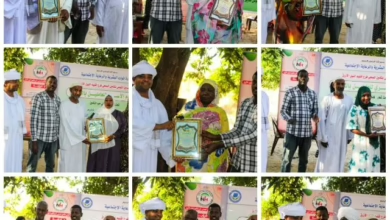
During last week, during the invitation of the third regional forum for innovative stakeholders in the Nile Oriental basin (Entro), he participated in a delegation from the Ministry of Irrigation and Water Resources, which included a group of experts and media professionals. The flight started from Sudan Port Airport, which is still affected by the effects of attacks to which it was subjected to the rapid support militia and its premises and regionalists. Despite the passage of a month or more than these attacks, the airport appeared in a deplorable state: the lack of water, the basic services and the air conditioners were disturbed in suffocating heat, which made the starting room a place to suffer more than a starting point.
On the other hand, the experience was completely different in Addis Ababa and Nairobi airports. Modern airports, professional operating systems, integrated services for upcoming travelers and transient and installations designed according to the latest international standards. High security measures. These scenes are not only impressed, but also to ask: why Khartoum, in all his history and his wealth, failed to build an airport worthy of Sudan? And why is the new Khartoum International Airport project locked in inclusion, despite the passage of years of announcement.
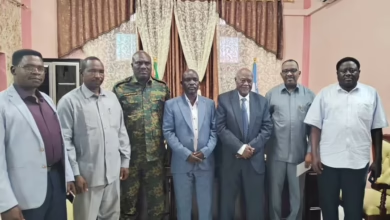
In this context, the Prime Minister, Dr. Kamel Idris, met yesterday, the director of Sudan Airports Company, Eng. Sir Al -Khatam Babiker, where the needs of airports and their qualification plans were examined. Despite the positive statements on an “upcoming rebirth”, the real performance of the Society of Sudan Airports raises a lot of doubts and questions, it could not even address the simplest aspects of the gaps in existing installations, such as poor hygiene, the worn rooms of the carrots which transport luggage and the air conditioning in airport rooms.
It is striking that countries like Rwanda, which left the genocide in the 1990s, managed to build Bugsira international airport with international specifications through productive investment partnerships. As for Ethiopia, despite conflicts and internal conflicts, he developed the “International Pollet” airport as a regional transport center, while Kenya has managed to update the Anteby Jomo Kenyatta airport “to become an influential air platform in the region.
These experiences prove that the rise in the rubble of war is not an impossible dream, but the direct result of a clear political will, strategic planning and implementation mechanisms which guarantee transparency and efficiency. Sudan is no exception, because it has human resources and technical expertise to achieve it, if the vision is found and that the conscious diligent leadership is available.
Talking about a coherent economic future necessarily requires the presence of modern doors. The airport is not only the facade of the state, but a major tool to stimulate growth, attract investments and facilitate trade. What is necessary today is not only a miserable maintenance of the airport, but rather the launch of an integrated national project to build airports with international specifications, starting with the new Khartoum airport, using innovative financing formulas such as the partnership between the public and private sectors (Boot), without total dependence on the state budget.
According to what we see from the face of truth, Sudan, in the post-war phase, does not have the luxury of the delay or inaction to evolve towards the spaces of the Renaissance, we must therefore rebuild the country through a strategic plan which begins from the first door: from the airport ground to put us on the right track. The real bet is on those who have the political and administrative courage to launch this beginning.
You are fine and well.