
Government of Hope: the bets of the sales and challenges of political action – the face of the truth – ✍️ Ibrahim Shaqlawi

In a political context, in which the parties of the interior and abroad are conflicts, and national priorities are faced with the accounts of satisfaction and fainy, the government of hope, led by Dr. Kamel Al -Tayyib Idris, tried an objective of the intermediate road between the possible and the available, and between the requirements of the administration of the State and the inheritance of the fragmentation and the inheritance.
From the first moment, Idris started as someone who adopts a tactic “absorbing surprises and taming the political scene”, through a graduate government training which does not block the way to the various components, but he does not reveal a clear cut project either. It is a cautious approach, which seeks to dismantle complications in closed rooms before being publicized, because Sudanese policy is managed by complex sales that go beyond the apparent decisions of hidden influence networks.
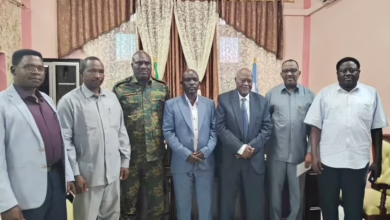
Five new ministers were announced yesterday in the Government of Hope, which brought names of professional efficiency and administrative experience, but they did not deviate from the logic of “rotation” within the ancient political astronomy, in particular with regard to the representation of the movements of the Juba agreement. There were no qualitative surprises, but well -known faces, some of which had previous transitional experiences that did not make concrete penetration.
Ministers such as engineer Mohamed Kartella, the federal rule, Dr. Gabriel Ibrahim Malian and Dr Abdullah Darf al -adl, are among the faces that have executive work tools, to various degrees.
Gabriel, despite his political dispute, has an economic experience which allowed him to manage the war file with a degree of sophistication, despite the challenges. As for Abdullah Darf, his choice is a detailed event; It is a person who devoted himself to the protection of the law and to the reflection of the principle of justice which is the pressure of the pressure of politicization and alienation. His appointment came with a nature of reform far from the logic of courtesy, to put him the task of correcting legislation, rebuilding judicial institutions and restoring confidence in the judicial system as a valve of state security.
In this context, the absence of the woman in the declared training is highlighted as a disturbing sign. The constitution modified for 2025 provides for the guarantee of an active representation of women in the executive authority of no less than a third party, which reflects its political and social role. However, what has happened so far has not exceeded the renowned Yaqoub in the Ministry of Industry and Trade, despite the expectations of the representation of women in at least three other bags. This absence is read as an indication of the weak political will in the implementation of constitutional obligations.
In parallel, the scene of the mass section was absent, this simple constitutional time, but it is very important. This scene is represented in the Sudanese political imagination, the moment of the real establishment and the time to declare the transition from the stage of fragmentation to the draft state. And his absence here can be explained by the absence of a clear vision of the government’s identity and project.
Instead of the collective section, a declaration of a coherent start, the appointments continued to be segmented, raised more questions than confidence. This absence, in the eyes of local public opinion and international partners, indicates a fragility in institutional construction, and gives the impression that the government is still “looking for itself”.
In the light of these data, the political moment requires decisive decisions that do not put the government in a defensive position, but rather give it the initiative. Otherwise, the opposition’s speech will recover its momentum and transform Kamel Idris from a “leader of the change project” into a person consumes the maze of daily controversy.
Objective reading indicates that the Government of Hope, so far, has failed to stabilize an equation that has paved the way to transform it into a complete national government. The vision is always disputed by the requirements of satisfaction, and the performance is always subject to equilibrium equations. However, the opportunity has not yet been closed. Some of the names, led by the Minister of Justice, can constitute real focal points to reset the path, provided that these names are transformed into a coherent work team, not just names in the scene of the scene.
This will not be achieved without a fundamental change in the way in which state affairs are managed. What is required now is not only the completion of names, but rather the completion of a real national project which takes into account the constitutional balance, reconstructs popular trust, gives women all their rights and provides a different model in power management.
The Government of Hope needs a political will to free it from small accounts, a vision of efficiency to loyalty and the right to satisfaction. Unless there are unsuccessful considerations, they run in dark pieces, they will inevitably reveal with the completion of ministerial training.
The declared ministerial training of the Government of Hope, according to the reading of “the face of the truth”, reflects a model of cautious political pragmatism, more than an expression of a strategic will for a structural transformation of the government. The absence of a total vision, and the priority of the logic of satisfaction with regard to the founding action, indicates a tactical management of the crisis, and not a global approach to reconstruct the state.
However, if this pragmatic, if invested in an institutional framework governed by law, is based on the inclusion of the representation and the effectiveness of performance, it may be able to establish a progressive transformation … until the discourse on “hope” becomes possible, not a slogan, but rather as a conversion in the definition of the State and its political and social function. It is only then that the government will be satisfied with the Sudanese.
You are fine and well.
Sunday July 13, 2025 ad shglawi55@gmail.com