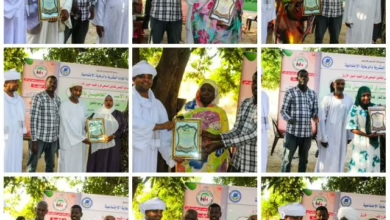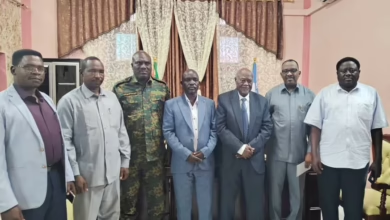

Train of returnees: an testimony of Egyptian -Odan Humanity and Solidarity – Something for the Fatherland – ✍️ Mr. Salah Gharibi

The time of the period stopped for a moment on the platform of the high dam station in Aswan, the day he witnessed an exceptional train. It was not an ordinary train carrying transient travelers, but he rather transported thousands of stories and hundreds of hearts this nostalgia for the fatherland. I was a witness, through my media, followed, on this rare human scene which embodied the greatest meaning of solidarity between two countries collected by history and blood: Egypt and Sudan.
The train was transferred from Cairo not only the luggage of Sudanese repatriated, but also the weight of the days of displacement, the bitterness of war and a deep desire for the fatherland. Their faces said that a light was waiting for them at the end of the dark tunnel. The most wonderful scene designed by Ambassador Abdel -Qader Abdullah, the consul general of the Republic of Sudan in Aswan, while standing on the sidewalk with the future, and their eyes speak of a homeland receiving his children with open arms. This scene in itself was a message of hope and warmth for all those who had experienced a severe trip.
What gave this scene a deep human dimension is the official high -level Egyptian effort in which this initiative was crowned. It was not only routine procedures, but rather the embodiment of historical loyalty to the brothers and sisters. Wise directives of sovereign leaders in the two countries, to direct the surveillance of the Governor of Assouan, the general of Dr Ismail Kamal, and the participation of all the institutions of the State, was the tight organization and the human crossing with distinction. Buses were ready to transport passengers from High Dam to Abu Simbel City, and from there to Kastal crossing, under precise administrative security and supervision, which reflected a great concern to provide all the comfort and safety of the repatriates.
This event was not only crossing limits, but rather a moment of return to the self, to the roots. The official Egyptian presence, of the Authority railways at the Ministry of Transport and Security in Assouan, was an instrument of loyalty of a district which is not broken in adversity, but is reinforced and renewed. This train was not only a means of transport, but rather a Najat ship, a corridor for the scope of what was interrupted and a human bridge which redraws the characteristics of Arabic solidarity at the time of a rare regional refraction.
In the words of the Sudanese repatriated, I approached Egypt, leadership and people, for the generosity of hospitality and shelter in its towns and villages. This thanks is a living testimony of humanity and the generosity of the Egyptian people, which confirms that relations between the two countries exceed the limits of geography and politics.
At High Dam station, where bars are on the exit and return novels, a new page of the relationship between the two peoples was written. This page was a clear title: when humanity speaks, all geography is silent. This scene has proven that human and historical ties are much deeper than all challenges or disputes. It is a reminder that geography can impose limits, but humanity does not know.
Humanitarian initiatives, such as those we have seen with the Sudanese return train, play a central role in strengthening the links between peoples in times of crisis. In the light of crises, the urgent need for support and support is highlighted. When people see tangible efforts to help them, it establishes a deep feeling of solidarity. These actions speak with a higher voice than all political declarations and reflect human feelings in a tangible reality.
The generosity, hospitality and good organization that Egypt has shown towards Sudanese, for example, generates a feeling of deep gratitude. This gratitude is not limited to people who receive help, but extend to all peoples, which strengthens a strong basis for confidence and mutual appreciation which continues even after the end of the crisis, as well as to create a positive collective memory, because large human situations are recorded in the collective memory of peoples. The story of the return train to Assouan will be told and transmitted as proof of fraudal relationships in distress. These positive stories are part of joint cultural identity and improve links for many years to come.
The crises often show unexpected challenges and require a quick and coordinated response. When countries and their institutions work next to the suffering, this breaks the obstacles that can exist and improve cooperation mechanisms in several areas, even those that may not be purely human, and during disorders, negative stories or attempts to feed tensions may appear. Effective humanitarian initiatives act as a conclusive evidence of common humanity and show the true face of relations between peoples, which refutes any attempt to disseminate the group.
In short, these initiatives do not provide simple logistical assistance, but rather an investment in long -term human relations. This proves that cooperation and sympathy are the strongest tools to build understanding and rapprochement bridges, even in the darkest conditions.