
Khartoum returns to the heart of the scene: the connotations of the first meeting of the cabinet after the Liberation ✍️ Dr Abu Al -Tayyib Adam Hassan Suleiman

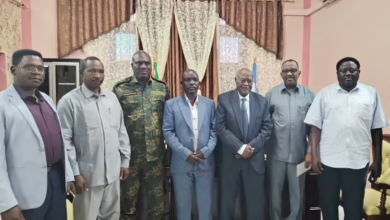
In an important stage in Sudanese political history, the first meeting of the Council of Ministers led by Dr. Kamel Idris took place in Khartoum, after his release from the grip of chaos and conflict, not to Port Sudan, as was the case in recent months. This scene, although it appears in its appearance simply a protocol to resume the work of the government, but in depth, it carries very important political and symbolic connotations, exceeding the limits of daily policy to touch the sovereign, the legitimacy and the reconstruction of the State.
–
Khartoum: the center returns to its normal place
Since the emergence of the modern Sudanese state, Khartoum has been a symbol of national unity and a center of power and administration. The transfer of the government to the Sudan port at the time of the crisis was only forced by security conditions, while the return today is a practical declaration that the historic capital has found its position and the Sudanese state has returned to its beating heart.
–
State sovereignty and reproduction of legitimacy
The first ministerial meeting in Khartoum after the Liberation is not a transient administrative event, but rather an embodiment of the restoration of sovereignty. The capital represents the mirror of the state in front of the interior and abroad, and the one who owns Khartoum has the initiative. This step confirms that the government is no longer in defense position, but rather regained its capacity to impose its presence in the most important cities of the country, which gives it a strong boost to restore its legitimacy and rebuild its institutions.
–
A message of victory inside and outside
Inside, this meeting reassures citizens that the State has regained control and that Khartoum has become sure to manage the affairs of the country. And outside, it sends a clear message to the international community that Sudan has exceeded the stage of collapse and that its institutions are able to progress again from its natural location. Thus, the meeting becomes a symbolic political moment to install the image of the government as a stable and not temporary authority.
–
Put an end to the “alternative capital” and a letter of adversaries
Port Sudan played its role of temporary capital during the crisis, but it was not and will not be a substitute for Khartoum. The government’s return to the capital of origin closes the “Internal Exile” page and confirms that the center has not moved. Likewise, the meeting sends a strong message to the opponents and the armed forces that the State has found the heart, and that any discourse on alternatives or the parallel authority centers is no longer proposed.
–
After symbolism: Construction challenges.
However, the real challenge for the government remains not only in the restoration of Khartoum, but also in the conversion of this symbolic victory into a political and economic project which reconstructs the State and realizes the aspirations of citizens. The return to the capital is an important step, but its success depends on the leadership management to achieve permanent security, restore services and attract internal and external confidence at the same time.
–
conclusion
The holding of the first meeting of the cabinet in Khartoum after the Liberation represents a historic moment which recounts a new stage in Sudan. It is a moment that combines symbolism and politics, between sovereignty and victory, and between the return of the center to its natural position and the start of the construction of the future. Regarding deep connotations, it puts the government to translate this political gain into tangible achievements in the lives of citizens.