
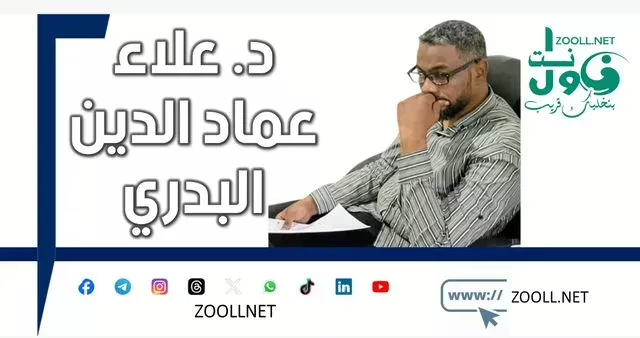
Diplomatic representation between the protocol and the interest of the fatherland ✍️ d. ALAA IMAD AL -DIN AL -BADRI
Each year, the United Nations General Assembly in New York takes place and the world leaders flock to deliver their words and examine their country positions on global problems. Despite the symbolism of this event, the legitimate question which must be boldly presented why the Prime Minister leads to the representation of Sudan in this international event? Is it not useful for the Minister of Foreign Affairs to do this task, in particular in the light of the complexity of the country’s internal conditions and the urgent need for the presence of executive management at home?
The participation of heads of government in these forums has made more “diplomatic duty” more than a strategic stage with concrete results. However, the deeper question goes beyond the names and positions to assign the feasibility of the participation itself in an international forum. In Sudan, we only gave ourselves the decisions that remained ink on paper and swinging situations which often prefer the interests of the great powers.
The General Assembly itself that the Prime Minister will now adopt the countries that have been and still provoke the suffering of Sudan and its continuous collapse of coups to the failure of effective support in the moments of determination of the decisions of the Security Council, which have often been used as pressure tools, not as justice, and we have in the Palestinian question the greatest proof, as well as Lebanon, Syria, Yemen, and the list, Lebanon, Syria, Yémère, Irame, List and List.
It is important to realize that the United Nations General Assembly, although it is an international dialogue and an exchange of opinions and posts, was not in many stations active insofar as the questions of the world in development, including Sudan, hoped, but that many of its decisions have remained without implementation or have found their way to postpone and procrastination because of the complications of international policy.
Sudan has experienced a number of Arab and African countries with painful experiences concerning the interaction of the international community with its problems, which puts question points on the extent of balance and justice in this international system, which is often moved by interest, and not principles.
Consequently, an examination of the way in which Sudan is represented outside and the nature of participation in such events is a sovereign problem with distinction and linked to the image of the image of Sudan in front of the world in a way that reflects its independence, respect for itself and its vintage on its external partnerships without neglecting its national decision.
We need a complete examination of this political mentality which always sees in Western countries the “Savior” and in the United Nations “Fair Umbrella” despite the date full of lethality. The Sudanese government must reconsider the way it deals with external files and begins to impose the prestige of the external Sudanese State instead of plowing behind the tables that we are not invited, except that the guests applaud them, not as partners who hear their voice.
The time of satisfaction, the time of compliments and the time of aspiration to the satisfaction of large countries must put an end to Sudan, a long country rich in history, its resources and its skills, and it is not appropriate that it is a certain number in the list of countries which await “international satisfaction” so as not to be a host, we will not be a host as sovereign countries which we need in the United Nations, position of Sudan and reflects his true interests in front of the world.
It is time for us to deal with international relations from the standpoint of peer and mutual respect, not from the position of dependency or anticipation, Sudan, with its resources, capabilitities and history that deserves to be active in the international arena, not only container of what oters decide that southern ‘ Vision of itself, not about others’ perceptions of it, and that the ambition of its children is to build a strong, independent and influencing state that preserves its position among nations.