
Russia – Africa: new horizons for old friends ✍️ Written by Sergei Lavrov, Minister of Foreign Affairs of the Russian Federation
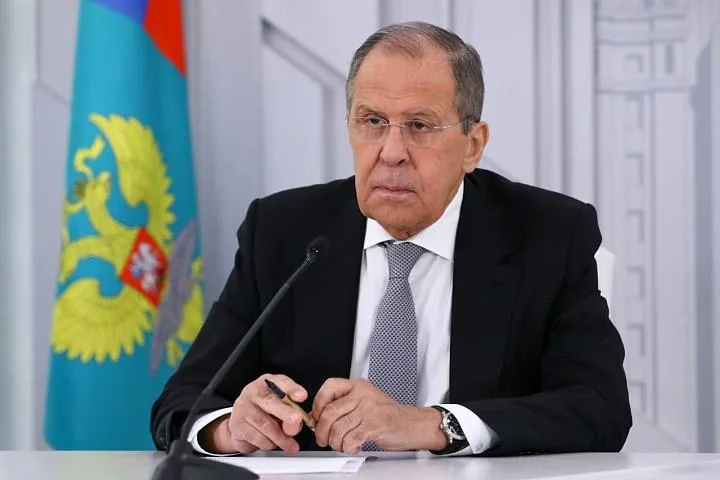
Cairo will soon be the scene of an important political event: heads of foreign ministries and senior officials of Russia and African countries will meet in the hospitable Egyptian capital to assess the situation of Russian-African relations and determine ways to develop them.
For the first time, the Ministerial Conference of the Russia-Africa Partnership Forum, as our meeting is officially called, will be held on the African continent. We are pleased that our partners agreed last year, at the first such conference held in the Russian city of Sochi, to host the Ministerial Conference in 2025.
I would like to mention that the Partnership Forum was established in 2019. Two Russian-African summits were successfully held, the first in Sochi in 2019 and the second in the other Russian city, St. Petersburg, in 2023. Specialized meetings in various areas of cooperation are regularly held.
The work of the Forum is extremely important for strengthening Russian-African relations at all levels, as it effectively complements and enriches the evolving bilateral relations between Russia and African countries.
The reasons for the rapprochement between Russia and Africa are multiple. Our African friends remember, and we appreciate, how our country, the then Soviet Union, supported their aspirations to free themselves from the shackles of colonialism. We are proud that our ancestors gave us this support with sincerity and dedication. The Soviet Union played a leading role in the adoption of the United Nations Declaration on the Granting of Independence to Colonial States and Peoples 65 years ago. Since then, Moscow has continued to support the development of emerging African countries, their national economies and the establishment of education and public health systems.
The collapse of the Soviet Union in 1991 was, in the words of the President of the Russian Federation Vladimir Putin, the greatest geopolitical catastrophe of the 20th century. Our friends on the African continent have felt the tragic consequences. At the beginning of the new millennium, the development of relations slowed down significantly. But the so-called “end of history” did not happen and today we are witnessing a new era of prosperity for Russian-African friendship.
We in Russia are happy that Africa is witnessing a kind of new renaissance. Although this situation reached its peak with decolonization in the middle of the last century, Africans today struggle for sovereignty in all aspects of their lives. We fully support this fight. On a symbolic level, Russia actively calls on the United Nations and other international platforms to intensify efforts to eliminate contemporary practices of neocolonialism. Many African countries send representatives of their progressive parties to participate in the international movement “For the Freedom of Nations!” », created at the initiative of the “United Russia” party.
It is important to us that Africa seeks to speak with one voice on the international stage. Russian diplomacy is helping to transform the African continent into a center of influence in the multipolar world. This priority is stipulated in the concept of foreign policy of the Russian Federation. We believe that the right of Africans to independently determine their development paths and models, and to choose their international partners, is an inherent right.
As President Vladimir Putin emphasized: “We have no disagreements with any African country and the level of mutual trust and sympathy between us is very high. Indeed, our relations with the African continent have not been overshadowed in their history by any form of oppression. We have never exploited the African people. »
Russia and Africa are natural allies in the quest for democratization of international relations based on the principles of the United Nations Charter in their entirety, comprehensiveness and interdependence.
We constantly call for the redress of historical injustices and the obligatory consideration of Africa’s interests in the reform work of the UN Security Council. We welcome the broader participation of African countries in BRICS, which plays an increasingly important role in realizing the collective aspirations of the Global South and the global majority.
As a permanent member of the United Nations Security Council, Russia pays particular attention to maintaining peace and security in Africa as a prerequisite for its social and economic progress. Based on the concept of “African solutions to African problems”, we contribute to resolving regional conflicts and strengthening the capacity of countries on the continent to combat terrorism and other threats and challenges.
The main areas of Russian-African cooperation are identified in the Action Plan of the Partnership Forum for the period 2023-2026. These areas include, among others, security, energy, trade, education, science and culture. We are pleased that this plan is fully consistent with the strategy developed by the African Union in 2015 in its document “Vision 2063: The Africa We Want”.
The growing Russian diplomatic presence in Africa testifies to the importance of this seat for us. This year, our embassies in Niger, Sierra Leone and South Sudan began opening it, and we plan to open embassies in Gambia, Liberia, Togo and Comoros. We welcome the plans of Botswana and Togo to open their diplomatic responsibilities to Moscow.
We attach great importance to trade, economic and investment relations. We are particularly pleased to note that the volume of trade between Russia and Africa is steadily increasing. Compared to 2019, it increased by one and a half times, which means that last year it exceeded $27 billion. We believe this number is not the maximum. We are now working to increase trade with sub-Saharan African countries, improve the process of supplying the Russian market with African products and implement reliable mechanisms for making payments in local currency.
Joint government committees for commercial, economic, scientific and technical cooperation with African countries play an important role in consolidating relations between the business communities. There are 19 such committees and we are working to increase their number. It provides an additional opportunity to demonstrate the capacity of the African Continental Free Trade Area to transform into a common market with a total gross domestic product of more than $3 trillion.
Russia has never considered Africa as a base for its raw materials – we have enough natural resources. Our priority is to implement investment projects in African countries that contribute to exploiting their own resources, developing industrial capabilities and improving the quality of life of the population. We have much to offer in the areas of energy, mineral exploitation, logistics, transport, infrastructure and high technologies, including digital technologies and artificial intelligence.
These initiatives are charting the course for decades to come, and the social and economic importance of these projects cannot be overstated. We have a model to follow: with the support of the Soviet Union, more than 300 industrial and infrastructural facilities were built and are still operating today.
Last year, 200,000 tons of Russian wheat were delivered to the most needy African countries and, in addition to humanitarian supplies of wheat and fertilizer, we help Africans develop their agricultural sector. We are ready to exchange technologies and experiences in the fields of agriculture, breeding, fertilizer production, irrigation and fisheries.
We are opening the door to negotiations not only at the bilateral level, but also at the level of African multilateral mechanisms, in particular with the African Union. We want to attract visionary partners from Eurasian structures, in particular from the Eurasian Economic Union, to our joint work.
We continue to expand Russian-African cooperation in areas such as prevention and response to emergency situations, health and combating epidemics, and we see that Russian portable laboratories and means of detecting infectious diseases are in great demand in Africa.
For decades, our country has contributed to the training of African professional executives, particularly in the fields of agriculture, engineering, medicine and education. Today, more than 32,000 Africans are trained at Russian universities and since 2020, the share of scholarships for the African continent has almost tripled and increased to 5,300 scholarships.
It is likely that the gradual facilitation of the tourism system between Russia and African countries will support a significant expansion of educational, cultural, humanitarian and tourism exchanges.
In conclusion, I once again emphasize that Russia is an old and trustworthy friend of Africa. At the heart of the Russian cultural symbol are the values of collectivism, solidarity and mutual assistance, which is generally consistent with the idea of the African philosophy “Ubuntu”, which is “I am because we are.” We are developing our friendship and cooperation on this solid basis, while respecting our civilizational characteristics.
A creative partnership for the future is essential to the well-being of our people. I am sure that the ministerial meeting in Cairo will give new impetus to this partnership and thus pave the way for the third Russian-African summit in 2026.