
Al -burhan: Between “we are fighting alone” and “we have allies” – the face of the truth – ✍️ Ibrahim Shaqlawi

This week has experienced important transformations on the Sudanese political scene, which can be included under the title: “stage tactics and political discourse sensors”. In this article, we seek to analyze these developments in its current and future context and to explain its connotations, in the light of the growing conversation of a political settlement led by the United States with the support of international and regional actors to stop the country’s continuing war.
In a remarkable development, the team’s first speech, Abdel Fattah Al -Burhan, president of the sovereign council, brought indicators on a strategic change in the directions of the Sudanese State and its security institutions. For the first time since the outbreak of the war in April 2023, proof of the traditional discourse of military leadership, to explicitly decide that “Sudan is not held alone, but has allies”, in an interview yesterday with the Spanish newspaper El Espanyol, which was reported by Al -jazeera.
This declaration came in conjunction with the purchase of negotiations held by the Committee of the Quartet, “America, Saudi Arabia, Egypt and Emirates”. Which was postponed from July 20 to 29 due to differences with regard to the solution … with a direction to attach Qatar and Great Britain to the committee. In order to impose a possible political regulations.
These regulations are based on reports and proposals published by American research centers, calling for the integration of DJEDDah and paths on a hybrid form which combines the narration of the Sudanese government with international pressure. This formula includes a joint political declaration, a unified administrative structure in Djeddah and a binding agreement issued by the Security Council.
This path reflects a new approach which depends on the imposition of raw diplomatic solutions through the tools of international influence, far from the Sudanese national dialogue, which raises fears of repeating the previous experiences produced outside the Sudanese will and has not led to real peace.
Nevertheless, according to the Al -Sharq newspaper, Washington has not yet crystallized a clear strategy for the crisis, which prompted Cairo and Riyad to intensify their efforts in favor of Khartoum, because the proof of “ally” isolation is a double message: first, that the Sudanese army is not a political isolated.
Second, it has a regional depth which goes beyond the limits of geography. He also pointed out that Sudan’s external relations will be built according to the positions of countries in war, and that certain forces are trying to impose notes which do not express the balance of real powers within the country.
This change in speech did not come isolated from reality on the ground, but coincided with the assignment of a committee led by General Ibrahim Jaber to restore security and services to the state of Khartoum. The committee began to exercise its functions at an accelerated pace, which included infrastructure reform and strengthening security in the capital.
In the same context, yesterday, an unprecedented wave of the return of Sudanese refugees from Egypt was witness in number which exceeded the previous rates, in an indication of an effort to restore civil and political life in Khartoum, and to establish it as a political decision center, in particular with the growing support of the Kamel Idris government.
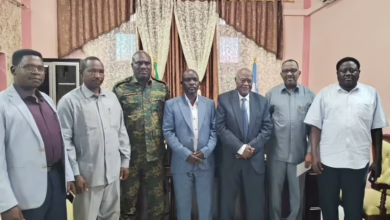
In a very important step, the proof made a sudden visit to Khartoum, where his plane landed at the capital’s airport for the first time since the start of the war. Hold meetings with the chiefs of staff, inspected armored vehicles, then visited the Sajana market and met a certain number of citizens. This tour sent a clear message: that the capital gradually returns to the state and that management is determined to direct its functions from the interior.
According to observers, it is planned that these movements will follow large military stages to regain control of the Kordofan and Darfur region, or at least to break the seat of the city of El Fasher. It seems that Sudan has started to adopt a clearer strategy to impose the fait accompli, in the restaurant of state institutions, by strengthening regional alliances and opening up to external support.
It is a strategy that transmits the discourse of “We are fighting alone” to “we have allies”, and suggest that Sudan has exceeded the emergency phase and began to act as a country which regains its sovereignty and prepared to negotiate from the position of power and popular support.
On the other hand, the international quartet remained rejected by the Sudanese to put an end to its involvement in engineering of the Sudanese scene which led the country to war, therefore this confusion between the complexity of the reality on the ground and the conflict of the interests of its members, threatening to thwart the next meeting.
This ambiguous situation allowed Qatar as a serious party, which moves quietly to present itself as an acceptable medium. The American envoy for Africa, Massad Paul, came from Doha at the start of the week to confirm that the conflict in Sudan “will not be resolved militarily”, and that “the only solution is a full political settlement”. But at the same time, he highlighted the low pressure tools and the absence of a uniform vision in the quartet, which raises questions about the gravity of this path.
In the light of this ambiguity, the Sudanese government seeks to stabilize its internal status and improve its regional and international relations to support army movements. The declaration of Al -Burhan reflects a position which does not accept negotiation and sends a direct message to the regional and international community, according to which any initiative does not take into account the national sovereignty of failure. The observers considered this declaration as a declaration of “veto” belonging to the army in the face of all the solutions working to bring the country before the war.
Thus, it seems that Sudan goes from the scene of the reaction to the stadium of the initiative: a new letter, announced by the allies, the return of management in the capital, the ground movements and a gradual return to the refugees. All these indicators lead to strategic characteristics aimed at stabilizing the state in wartime and imposing it as reality in regional and international accounts.
You are fine and well.
Wednesday July 23, 2025 AD
Shglawi55@gmail.com