
“Arabic agriculture day”: Green Oasis and Iyads who rebuild in Khartoum – something for the fatherland – ✍️ Mr. Salah is strange

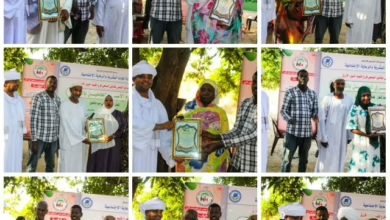
Arab agriculture day, celebrated by our Arab Agricultural Development Organization (AOAD) The twenty-seventh September of each year, is a lighthouse of deep reflection on the question of food security and the role of the earth which is the cradle of our civilization. It is not only a celebration, but rather a renewal of the alliance with the earth, and an opportunity to highlight the growing roles of vital institutions and agricultural environments in the heart of our Arab homeland.
The Arab Organization for Agricultural Development (AOAD) is based on Khartoum, the capital of Sudan, the Prince, its head office since 1972, and today, in the midst of the challenges of the region, it gains significant importance. Khartoum, the unwavering and liberated city, represents the heart of the agricultural nation, and, in turn, it is historic responsible for the main efforts of agricultural development, in particular at the stage of reconstruction and stability.
The organization’s roles continue to be more complete and more influential to direct the food security strategy and work to achieve agricultural integration between Arab countries, and focus on projects that increase agricultural productivity, in particular in abundant resources such as Sudan, support the resilience of agricultural sector in the light of crises, highlights the need to support farmers and make any contributions and Promote intelligent technologies to adapt to agricultural expanses and to promote intelligent technologies to adapt to agricultural expanses and to promote Smart technologies shortages, as well as the improvement of the role of oases and work to protect the unique ecosystems of oases, because they are a key source of life and heritage, which is consistent with the slogan Celebration of the organization of 2025: “Work together to support oases and improve their ability to adapt and seduce firmness.”
Oases in the Arab world, including the oases of Sudan, remain a symbol of firmness in the face of desertification and the rarity of water. These oases are not only green spots, but rather integrated life systems, natural warehouses for biological diversity and water, and a cultural heritage incubator. It represents ancient Arabic intelligence by adapting to the environment of the hard desert.
In Sudan, where environmental and social challenges are raising, the oases acquire a pivotal role and the oases contribute to local food security by providing food and income to residents of dry and semi-series areas, which reduces pressure on cities and improves rural stability, as well as preservation centers for agricultural identity, heritage and traditions Inheritis, which must be preserved and improved by development projects.
The Oasis Al -Bashir comes to Sudan, which is the house of our capable poet and the majestic writer Muhammad al -Makki Ibrahim (born in Al -Abyad), as a model for the richness of these environments. The poet from the maximum oasis of Al -Bashir seeks: “As indicated in one of the writings on him, embodies in his poetry the depth of the link between the land and the identity. Al -Bashir Oasis reminds us that agriculture is not only economic numbers, but rather a culture root increase in the nation.
The day of Arab agriculture is an invitation to work hard. Agriculture is the real key to achieving sovereignty over food and resources. We must adopt a strategic vision that makes the Arab earth, its oases and its extensive projects, the engine of the reconstruction of Khartoum and all that was destroyed by conflicts. By investing in sustainable agriculture and protecting oases, and allowing the Arab agricultural development organization to play its pioneering role in full capacity in its capital, Khartoum, we guarantee future generations, fertile, safe and prosperous land.
Let us contemplate the poems of Muhammad al -Makki Ibrahim, and consider the oasis as a green poem that we must warn the wilting factors and make the day of Arab agriculture a real beginning towards irreversible food security and sustainable development which does not withdraw.