
Broidcen workshop in Kuala Lumpur: Sudanese Islamists between examination and renewal and requirements of political and social intelligence to meet the challenges of the scene ✍️ Abu al -tayyib Adam Hassan Suleiman
introduction :–
A dialogue workshop organized by the Broidcen organization took place in the Malaysian capital, Kuala Lumpur. This workshop came in the light of the complications of the Sudanese political scene, and the position of the Islamists withdrew after the fall of the Bashir regime, as well as regional and international transformations that have noted questions about the future of political Islam in the region.
We seek to analyze the history of the workshop, to assess their results and to discuss their future vision, while taking advantage of comparative experiences in the Islamic world.
–
First: Historical context and motivations: –
Since the 1940s, the Sudanese Islamic movement has become an influential political and social force and still represents a difficult power which is underestimated in the Battle of Sudanese dignity. Where she witnessed the stages of the Ascension by her participation in the June 1989 revolution, then her political slit fell because of the divisions (National Congress / Popular Congress, as well as the subsequent divisions of the National Congress and the People) and successive leading crises. After the December 2018 revolution, the Islamists were faced with unprecedented challenges in political exclusion and marginalization, social and economic isolation, the battle of dignity and other pressures of the international community which were dated from Islamists in Sudan.
Why did you choose Broidcen, the Malaysian capital, Kuala Lumpur, to kiss the workshop: –
The choice was not random, due to the symbolism of the Malaysian experience, which is an open Islamic environment which represents a model for a political experience and development which has succeeded in combining Islamic identity with the requirements of development, democracy and openness to the world.
Workshop objectives: –
1. Treat the internal fragmentation between Islamic parties.
2. Research of an inclusive discourse that goes beyond past crises.
3. The Islamist website must be pronounced in any future political regulations.
–
Second: theoretical and comparison framework
This vision is based on the approach to the analysis of the political discourse of Sudanese Islamic parties within the framework of the theories of the democratic transition, with the need to benefit from the experiences of Islamic parties in other countries such as:
Türkiye: The Party of Justice and Development as a model of pragmatism and the employment of Islamic identity in a democratic framework.
Morocco: The experience of the Justice and Development Party and the challenges it has suffered from the deep state.
Malaysia: The combination of economic reform and Islamic identity (Mahathir Muhammad / Anwar Ibrahim).
These experiences provide important lessons to Sudanese Islamists on the balance between identity and citizenship, and between ideology and pragmatism with the need to strengthen a societal consciousness characterized by a great capacity for political and social intelligence to face the challenges of the time and its pressures at the lowest cost and losses to move to the Battle to establish the state of modern Sudanese. Whatever the Sudan will continue to move from the battle of the bones to break to another in a spiral which has no first and no others. Violence and counter-violence, based on the facts of the history of modern Sudan since independence so far
Third: the basic results of the workshop (which are directed to all political elites in Sudan and are not directed to the elites of political Islam only)
1. Diagnosis of the crisis
The lack of confidence between Islamic factions on the one hand and the other Sudanese factions on the other hand.
Weak effect on the Sudanese street.
The absence of a modern national political project that everyone can.
2. Cash examination
Recognizing the errors of the previous experience in the decision for all parties.
Acceptance of the concepts of citizenship, rational governance, peaceful coexistence as an alternative to the discourse of exclusion and lack of acceptance and recognition of the other.
Fourth: evaluation:
Benefits: –
The workshop broke the stagnation of relations between Islamic currents.
She has shown preparation for self-criticism.
He was carrying indicators to accept the opening to other powers.
Negatives: –
Participation has not included all influential Islamic factions, which has reduced the completeness of the results.
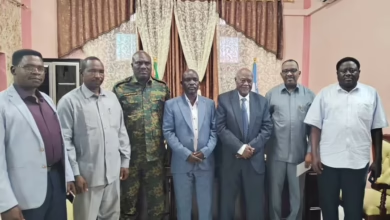
Where she participated: –
1 / The reform movement now
2 / The National Conference, Ibrahim Mahmoud pavilion
3 / The national movement for construction and development
4 / Sudan Building Party
5 / The reform and national change party
The absence of young people and women is the weakest action.
Recommendations if a theory remains without a clear executive plan.
–
Fifth: current challenges: –
The Battle of Sudanese dignity and its challenges.
Political exclusion in the light of Sudanese tensions without recognition of the other.
Regional transformations (opening of the Gulf, change in Egypt, climbing civil movements).
The Sudanese economic crisis which requires a practical discourse which goes beyond ideology.
–
Sixth: future vision
1. Durability: Convert workshops into a continuous process thanks to periodic meetings and intellectual platforms.
2. The national project: – Crystallize a balanced vision between Islamic identity and civil status.
3. Opening: Establish partnerships with non -Islamic forces to overcome misunderstandings and build a communication and understanding bridge in order to find common ground.
4. The involvement of young people and women: their integration into the direction of political action.
5. FGRAMICS: Focus on education issues, economics and national reconciliation.
6. Use mechanisms: —-
A short -term plan: – (strengthen confidence between factions).
Average medium plan: – (production of a new political discourse).
Long -term plan: – (integration into a full national regulation).
–
Open and legitimate research questions for all Islamists and secular parties in Sudan:
How can Islamists settle the concept of “democratic civil Islam” in Sudan?
What are the limits of possible concessions that Islamists and secular parties can make in exchange for integration into the political process which are not excluded in Sudan?
–
conclusion
The Sudanese Political Scene in General and the Sudanese Islamic Parties Stands in Particular TODAY AT A HISTORICAL CROSSROADS: But How can Sudanese Islamists Read the Sudanese Political Reality and Its Surrounding Challenges and Unprecedented Challenges and Crises and Extract the Lessons and Lessons Learned To Reproduce National Project With A High Return and at the Lowest possible Cost and Reflects the Intelligence of the Usual Islamists and Addresses The Roots of the Sudanese Problem in Preparation for the start to spacious national spaces.
The Broidchen workshop represented an important first step towards examining and renewing, but its success depends on the capacity of all different Sudanese forces to go from the theoretical box to the verbal box, and to the extent of its absorption of the real transformations that Sudan and the world cross.
Dr Abu al -Tayeb Adam Hassan Suleiman
The founder of the Sawa Sudan initiative first towards the vision of Sudan 2060
Elayebumda@gmail.com