
Desire and dress in a free .. – The face of the truth – ✍️ Ibrahim Shaqlawi
While Sudan approaches the exit of the war, attention is addressed to the political process and development to rebuild the State, after the events revealed the fragility of official institutions. In this context, civil society appears as a vital player to fill the void and provide effective alternatives that contribute to the promotion of stability and the restoration of security and peace, far from chaos scenarios.
This step witnesses a remarkable increase for civil society organizations as one of the main players in the process of reconstruction of the State and society, in particular in the absence of the central state of certain areas, due to the scarcity of resources and the low infrastructure affected by war.
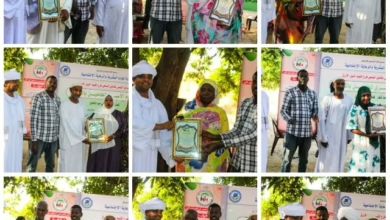
In this context, the return to the field of each of the “best friend” and organization “Ashwaq Development” charitable associations in the capital, Khartoum, represents a qualitative change in voluntary work, which combines moral duty and administrative organization. This yield expresses a call for voluntary activities and indicates a possible issue of the role of civil society in the restoration of the national fabric and the improvement of the values of participation.
Sudanese society is famous for the culture of “Nafir”, where companies are automatically joined, whether in terms of individuals or groups, to deal with the crisis and challenges.
The best association of friends launched his return with a meeting with my reflection which included his members returning from abroad, during which he confirmed his humanitarian and social commitment to weak groups. It is reported that he had previously organized the activities of the International Day of Down syndrome, in cooperation with the International Center for Children’s Development, in a stage of conscience which reflects the awareness of the association to the importance of overcoming direct rescue work to build an inclusive culture that respects diversity and improves social justice.
In parallel, the Ashwaq development organization presented an integrated perception of the voluntary return of the displaced, through an analytical document which dealt with security, economic, political and institutional challenges that hinder this return. The article – from which the writer obtained a copy – indicated that generous and safe yield cannot be reached without reconstructing societal confidence, restoration of basic services and the creation of economic solutions which take into account the reality of affected families.
He also called for the activation of triple partnerships between the State, civil society and the private sector, in what can be called “the national institutional soul”, a vision which redefines the relationship between the citizen and the State on a new participatory basis.
Regional experiences offer employment models in the Sudanese context; In Lebanon, after the civil war, civil society organizations played a central role in filling the emptiness of the state and provided vital services thanks to partnerships with the European Union and the United Nations agencies. In Yemen, local organizations have directed rescue and rehabilitation efforts after the collapse of the state, according to the Gulf and international support and the interventions on the decentralized land which have strengthened the consistency of local communities. What combines these experiences is the clarity of the vision, the independence of the decision and the construction of balanced partnerships with the outside without neglecting national sovereignty.
In the middle of this growing dynamic, a project question shows: where is the Sudanese red crescent? It is the entity which is supposed to direct the assistance and reconstruction scene because of its ancient history and its international subscription. His absence in a critical moment as this requires a serious examination: the problem of governance and financing? Or in political and administrative interactions?
In addition, the absence of active national organizations, such as the national network of volunteers, the Sudanese Council for volunteer organizations “ESKOVA” and the alliance of Sudanese civil society organizations, reflect a deep defect in the institutional institutional structure which was supposed to direct humanitarian and developmental response efforts.
Given that we know that the Sadiq Ismail, the advisor of the President of the Sovereignty Council for the Human Sciences and Organizations, is interested in this file, we hope that you will find promising national initiatives, such as “Ashwaq for development” and “the best friend”, which it deserves support and installations, in addition to revising the status of other national organizations which are still outside the circle of action, role.
According to what we see from the face of the truth, the greatest challenge in Sudan today is not limited to suppressing the effects of war, but rather extends to the re-establishment of a system of government which connects the State to society through effective and lasting channels. Organizations such as “Best Friend” and “Ashwaq Development” providing inspiring models to rebuild this link, by supporting popular initiatives, in participative work with official authorities and international partners. The success of this experience, without a doubt, will help draw a more stable future and restore consideration to civil society as a major partner in the development and peace industry.
You are fine and well.