
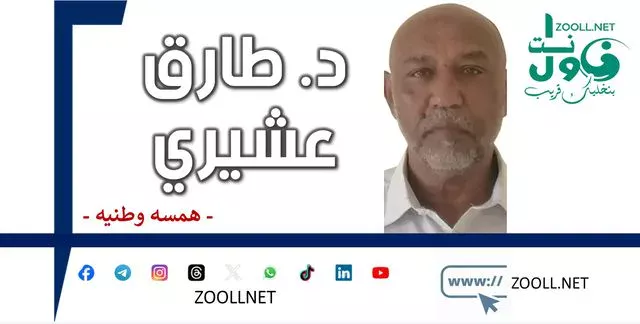
Does the political mentality change in Sudan? – National Whisper – ✍️ Dr Tariq Ashary
In the moments that followed the wars, it is not enough to restore what is destroyed by structures and buildings, but we must rather restore what has been destroyed in the hearts of people, in the methods of their thought and in their political lifestyles which could have been one of the causes of the explosion
Sudan, after the war of dignity, stands at a decisive crossroads, either to reproduce the past with all its failures, or we choose with a national advanced political system (how we succeed)
The war has proven that there is no doubt that crises in Sudan were not only the result of external plots, but rather of the result of internal accumulations, great political errors and a disturbing political lifestyle which does not express the aspirations of the Sudanese citizen and does not take into account its diversity. Authority has remained exclusive to tight elites, to submerged loyalty to efficiency, and wise state institutions were absent, and the absence of the political methodology that places its card is a route
And the collapse of institutions and the displacement of millions of people emerged a bitter fact that our continuation in the same political path means that we have learned nothing from our pain and that we are preparing to come.
Changing the style of political life after the war is no longer a luxury, but has rather become an existential necessity, according to the unity, the stability and the future of its future generations.
In light of the tragic conditions in Sudan since the outbreak of war, vital questions about the future of the country, led by a pivotal question:
Does the political mentality change in Sudan?
The war revealed the depth of the fault of the political structure and the failure of the elites to present a complete national model. The Sudanese political mentality remained hostage to the conflicts of the parties, the tribal alliances and the regional range, which led to the production of a fragile state, that the institutions were absent and controlled by narrow loyalty.
A new Sudan cannot be built with an old state of mind. What is necessary now is a revolution in political conscience that is starting to redefine concepts:
Politics is not a means of empowerment, but a tool to serve the people.
This power is not a loot, but a responsibility.
The first affiliation must be for the homeland, not for the tribe or the party.
This revolution does not start from the Republican Palace, but rather from school, university, mosque and market, and all platforms that can reach an idea and create a conscience.
What can change the political mentality?
. A new generation that believes in citizenship and efficiency rather than loyalty and regionalism.
. Free and fair media make a responsible public opinion.
. Young movements adopt change, not just rebellion.
. An educational system that promotes critical thinking and national affiliation.
Obstacles
But this change will not be easy. There:
Animals benefiting from the status quo.
The external forces use the division in their favor.
A culture of fear and intimidation of change.
It is not impossible to change the political mentality in Sudan, but it requires collective will and moral courage to face yourself first, before facing the other. The new Sudan will not be born from the uterus of temporary agreements, but rather a permanent consciousness which produces a new elite with a real national spirit.
Are we ready for that?