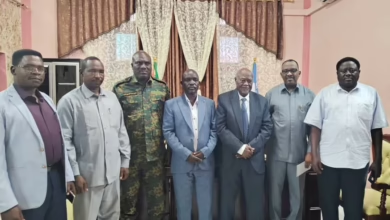

Interior: the challenges of security and restoration confidence – the face of truth – ✍️ Ibrahim Shaqlawi
It has often been hesitated before embarking on this article, for two systematic considerations which call for precision. The first is that the subject of the writing of that time relates to the Minister of the Interior, a person whom I know closely “a neighbor of the neighborhood”, who can be the shadow on the neutrality of manipulation, and the writer puts in an ambiguous field between personal appreciation and professional analysis, which requires more impartiality and balance.
As for the second, this is what is imposed by the requirements of discreet political writing on the need for strict differentiation between professional discourse of public opinion and social discourse which is desirable to remain in the circles of social relations.
With the awareness of these two considerations, which the Ministry of the Interior witnesses Sudan today represents a qualitative change in the way to the restoration of the Sudanese State for its well and its prestige, in particular with the return of the ministry with its complete staff to Khartoum, as a practical step towards the reconstruction of the security system, its public confidence.
This decision by the team, the Babiker Samra Mustafa, must be read in the context of the administrative vacuum commission, as well as the urgent need to restore the security establishment within the complex political and security scene that the country is going through.
Current security challenges are not limited to the control of traditional crime, but rather include existential threats which affect the structure of the state itself and require non-traditional strategies, a balance between the imposition of the prestige of the law and the protection of the societal fabric.
The capital, Khartoum, in the parties, still suffers from aspects of uncontrolled security insecurity, in a context which reflects the fragility of the security system. This reality requires the adoption of a new security approach based on the restructuring of the propagation of the police and the intensification of biological axes, while providing the necessary logistical and human capacities. It also requires the activation of control mechanisms on the ground with a high quantity of rigor, according to new criteria that meet the complexities of the current step and post-war requirements, far from compliments.
Also from urgent challenges, the rehabilitation of the infrastructure of police stations in terms of administration and service, which was greatly affected by war, which makes it possible to accelerate its restoration and modernize its work systems, in particular with regard to the fight against endemic and crossed crimes.
The security protocols signed with fraternal and friendly countries must be activated, allowing the exchange of experiences, the transfer of modern technologies and the construction of partnerships in the fields of training and information. This is an essential point of entry to rehabilitate the security sector in a way that improves its ability to play its role effectively and contributes to the restoration of stability.
The file of control of foreign presence in the country is also one of the complex questions which require a complete examination of regulating laws and policies, in a manner which ensures the preservation of internal security without prejudice to the principles of human rights and the obligations of Sudan linked to international laws.
What is remarkable about the performance of the Minister of the Interior after his appointment is his presence in the field and his passion for being in the capital, Khartoum, as a residence for effective administration of security operations. In addition to important executive decisions, the most important is the transfer package, which included 64 dean officers, in a decision that reflects a clear desire to restructure administrative and renew the blood of the leaders. This related effort is read in the context of the restoration of safety and severity of the treatment of security problems that arise after the wars.
The importance of reinstating the human framework of the police forces which have been referred to the public interest cannot be ignored or temporarily far from the service during the period of war, because they constitute an essential balance of experience at this specific stage.
The most important challenge before the Ministry of the Interior remains today to strengthen confidence between the citizen and the police, according to a new equation, based on the importance of the societal partnership by the return of “complete security” in the districts, as well as the control of negative phenomena in all its forms and the implementation of the law strictly to support stability and security.
This requires a vision that goes beyond the traditional concept of security, to include the protection of weak companies, the promotion of peaceful coexistence and the support of the voluntary return of the move, which are the dimensions that the ministry has already started to deal with through the National Committee for the Protection of Civilians.
Between the restoration of security, the improvement of performance and confidence, according to the face of the truth, the Ministry of the Interior, led by the Minister-Lieutenant-General Babiker Abu Samra, stands before a difficult national test, but it is not impossible, as long as there is a serious political will, a clear professional vision, and a deep conscience that security is not an end in itself, but a fundamental condition for the construction of a state of a trait and a state of a state and a state of a state of a trait and a fair state.
You are fine and well.
Monday July 7, 2025 ad shglawi55@gmail.com