
Kamel Idris .. Welcome to move – the face of truth – ✍️ Ibrahim Shaqlawi
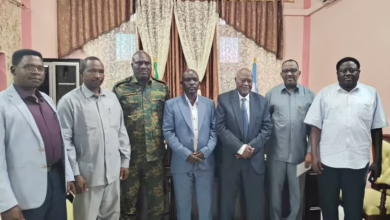
In a national scene that took place in the city of Port Sudan, Dr. Kamel Al -Tayeb Idris swore as Prime Minister, to start a new chapter of political transition in Sudan, after an executive vacuum that lasted four years. At the time of appointment, constitutional measures exceeded a real test of the remaining hopes to save the way from the Sudanese state.
There is no doubt that the choice of Dr Idris at present reflects the conscience of decision -makers according to which the scene requires a person with national efficiency and an international experience, capable of addressing inside and budding outside relationships. The man, with his academic and diplomatic biography and his departure from partisan conflicts, was widely accepted and raised the ceiling of expectations on what he could accomplish … in particular since yesterday, he presented a speech which expressed a promising action plan.
However, the reception that IDRIS has encountered, whether at the street level or through communication platforms, reflects not only the acceptance of his person, but also reflects a general conversion to get out of the crisis tunnel, and aspires to the efficiency capable of meeting post-war challenges.
What can be clearly observed in the interactions of Sudanese with his appointment is that the reception was not confined to his person or to his autobiography, but rather widened to include political action itself, going from the reality of war on the horizon of peace, and from the emptiness of power to the characteristics of a state. The Sudanese who lived chaos and collapse, no longer seek an “individual savior”, as much as they turn to a new start that redefines the state as a security, services and institutions, far from wars and fights.
Consequently, the Idris reception expresses what can be called “minimal hope”; In other words, welcoming the idea of the same transition, whatever its people: from the authority of the militia to the rule of law, and from fear and fragmentation to a law system which can be predicted.
In this context, his speech acquires strong connotations, while the transition of a delayed country surrounded by conflicts, to a possible country which prevails in matters of security and peace, and zero square speeches which distinguished the parties during the last period, to a national political project which can be implemented on the ground.
The moment of the appointment of Idris is not without important significance; It comes in the shadow of a political and legislative void, and a large economic deterioration and services, as well as security disorders. The man came to power after Sudan received his full part of failure and political divisions, since the fall of the Bashir regime in 2019, and subsequent armed violence has torn the national fabric and left complete destruction in several states.
In the absence of an active legislative council and the continuation of the ministers of armed movements despite the end of their mandate under the peace agreement of Juba, the new Prime Minister stands out for a structural dilemma linked to the legitimacy of the government team itself, and to the interference of the powers and the absence of institutional clarity which has long bothered the Sudanese State. Here, the importance of his experience and his wisdom occurs, and the extent of his ability to persuade the different forces to form an exceptional team that establishes a new stage.
It is important to distinguish between the “legitimacy of appointment” and “legitimacy of success”. The president of Sovereign Council, the first team, Abdel -Fattah Al -Burhan, gave Dr Idris Wide Power to form a new government after the Aid Al -Adha holidays. However, these powers, despite their importance, do not guarantee success in a turbulent political context, unless they are supported by a national incubator and a clear government project. Here, the greatness of the Sudanese people is obvious in their support for man.
Without a collective political will, it goes beyond the logic of quotas and adopts a real constructive project, the appointment of Idris will continue to be an administrative step without a real horizon of change. The challenge is not only the formation of a “new” government, but also to redefine the function of the transition rule and consolidate the principle of good governance in a period characterized by institutional fragility.
The images that the activists circulated towards the Prime Minister bow down to God, thanking when he arrived at the Sudan port, although influencing his connotations, but they are not sufficient to form a national consensus on his ability to accomplish the desired transformation. Sudanese expect what is greater than symbols and emotions; They await a real administration of the reconstruction file, ending the fragmentation, improving the pension of people and restoring confidence in the institutions of the government and the State.
According to what we see from the face of the truth, Sudan needs what we can call a “new social contract”, which puts an end to the state of division and establishes the state of the institutions. In this context, Kamel Idris should not be considered as “the individual rescue man”, but rather as an introduction to the formulation of an inclusive political path. As Dr. Imad Al -Din Khalil says: “Events do not make history, but rather the conscious will that takes up the moment of the event and transforms it into a project.
You are fine and well.
Monday June 2, 2025 ad shglawi55@gmail.com