
Minister of Human Resources and Social Protection: they are determined to provide funding for health insurance projects and to extend the coverage service
The Minister of Human Development and Health Care: a tendency to enter into tax health insurance and to make it compulsory for all workers.
Director of the National Health Insurance Fund: The number of subscribers reached 35 million and the population coverage rate is 86.2%.
The Minister of Human Resources and Social Protection, Professor Mutasim Ahmed Saleh, stressed the need to introduce all citizens under the aegis of health insurance, stressing the importance of activating compulsory law in health insurance and the inclusion of tax health insurance as a compulsory procedure for all insured workers.
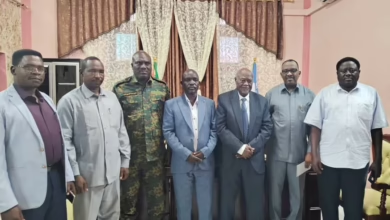
This came during his first visit to the presidency of the National Health Insurance Fund in the city of Port Sudan, where he was held on the ground on public services and departments, and examined the message of the Foundation and its role, and identified the directors of branches in the regions and the States, in addition to the challenges facing the National Health Insurance Fund.
Mu’tasim said that the fund was still providing high -quality medical services despite war conditions and covers the need for citizens, as the percentage of health services coverage has reached 80%. He added that in spite of losses suffered by health establishments at the center and in the States, there is an aspiration to enter more than 95% of citizens under the aegis of health insurance, noting that the war had made a large number of citizens in a difficult economic situation.
He said that the size of losses is not yet known due to the occurrence of a number of states under the control of the militia, but the fund was able to provide comparable services at the level of certain external countries.
The Minister signed up, during the enlightening meeting on the performance of health insurance and future prospects which were held today at the headquarters of the fund at the Sudan port, to reach concrete stages in the widening of the coverage circle during the first hundred days of the Prime Minister’s government. He also called for the rehabilitation of affected health establishments and their operation to serve Sudanese inside the country and moved to Egypt, Chad, Libya, Eritrea and Uganda.
He stressed that the financing shortage has negatively affected the quality of the services, as well as the lack of commitment to pay the contributions, which was reflected in the quality of performance.
The Minister called for improving the level of services and avoiding gaps, noting that workers in the fund made enormous efforts during the war to ensure the continuity of insurance services, highlighting its commitment to provide government funding and the activation of partnerships with friendly and regional and international organizations in order to provide high quality services to citizens.
He praised the vital role that the fund played in the treatment of the insured in the light of exceptional circumstances, revealing the next humanity in the hundred days plan, aimed at obtaining wide population coverage in safe areas and released states, as well as eligible health centers, and to provide necessary health services during the remaining period of the current year, while urging the official authorities to pay the necessary obligations.
For his part, the director of the National Health Insurance Fund, Dr Farouk Nour Al -Daim, presented a complete illumination on the work of the fund and the current challenges, noting that the buildings and the health centers of the funds were attacked by the militia.
He pointed out that one of the most important future challenges is the issue of pharmaceutical supply, as the list of basic drugs of the national fund includes 690 articles, 75 new articles have been added which will be provided by the National Fund for Medical Supply, explaining that health insurance pays 75% of the cost of the drug.
He said the number of health insurance participants had reached 35 million, while the current population coverage rate reached 86.2%, and the coverage rate for poor families reached 75.5%, including 7.5 million families funded by the Ministry of Finance.
With regard to infrastructure, he explained that the number of health facilities by the end of 2022 amounted to 3,555 installations, and this number decreased following economic conditions and war at 894 facilities, distributed more than 1047 points of sale in the first half of 2025.
He noted that health insurance has more than 354 typical health centers for the provision of health and treatment services, offering an overview of the strategic quarter-cornea plan for Health Insurance (2007-201), while strengthening the 2025 plan which focuses on sustainable funding, diversification of income sources and rationalizing control and drainage on health services.
–
naturally! Here is the text after having corrected it linguistic and revise it while maintaining the complete content:
–
* Minister of Human Resources and Social Protection: they are determined to provide funding for health insurance projects and extend the coverage service *
* The Minister of Human Development and Health Care: a tendency to enter into tax health insurance and make it compulsory for all workers *
* Director of the National Health Insurance Fund: The number of subscribers has reached 35 million and the population coverage rate is 86.2% *
* Port Sudan – Mohamed Mustafa *
The Minister of Human Resources and Social Protection, Professor Mutasim Ahmed Saleh, stressed the need to introduce all citizens under the aegis of health insurance, stressing the importance of activating compulsory law in health insurance and the inclusion of tax health insurance as a compulsory procedure for all insured workers.
This came during his first visit to the presidency of the National Health Insurance Fund in the city of Port Sudan, where he was held on the ground on public services and departments, and examined the message of the Foundation and its role, and identified the directors of branches in the regions and the States, in addition to the challenges facing the National Health Insurance Fund.
Mu’tasim said that the fund was still providing high -quality medical services despite war conditions and covers the need for citizens, as the percentage of health services coverage has reached 80%. He added that in spite of losses suffered by health establishments at the center and in the States, there is an aspiration to enter more than 95% of citizens under the aegis of health insurance, noting that the war had made a large number of citizens in a difficult economic situation.
He said that the size of losses is not yet known due to the occurrence of a number of states under the control of the militia, but the fund was able to provide comparable services at the level of certain external countries.
The Minister signed up, during the enlightening meeting on the performance of health insurance and future prospects which were held today at the headquarters of the fund at the Sudan port, to reach concrete stages in the widening of the coverage circle during the first hundred days of the Prime Minister’s government. He also called for the rehabilitation of affected health establishments and their operation to serve Sudanese inside the country and moved to Egypt, Chad, Libya, Eritrea and Uganda.
He stressed that the financing shortage has negatively affected the quality of the services, as well as the lack of commitment to pay the contributions, which was reflected in the quality of performance.
The Minister called for improving the level of services and avoiding gaps, noting that workers in the fund made enormous efforts during the war to ensure the continuity of insurance services, highlighting its commitment to provide government funding and the activation of partnerships with friendly and regional and international organizations in order to provide high quality services to citizens.
He praised the vital role that the fund played in the treatment of the insured in the light of exceptional circumstances, revealing the next humanity in the hundred days plan, aimed at obtaining wide population coverage in safe areas and released states, as well as eligible health centers, and to provide necessary health services during the remaining period of the current year, while urging the official authorities to pay the necessary obligations.
For his part, the director of the National Health Insurance Fund, Dr Farouk Nour Al -Daim, presented a complete illumination on the work of the fund and the current challenges, noting that the buildings and the health centers of the funds were attacked by the militia.
He pointed out that one of the most important future challenges is the issue of pharmaceutical supply, as the list of basic drugs of the national fund includes 690 articles, 75 new articles have been added which will be provided by the National Fund for Medical Supply, explaining that health insurance pays 75% of the cost of the drug.
He said the number of health insurance participants had reached 35 million, while the current population coverage rate reached 86.2%, and the coverage rate for poor families reached 75.5%, including 7.5 million families funded by the Ministry of Finance.
With regard to infrastructure, he explained that the number of health facilities by the end of 2022 amounted to 3,555 installations, and this number decreased following economic conditions and war at 894 facilities, distributed more than 1047 points of sale in the first half of 2025.
He stressed that health insurance has more than 354 typical health centers for the provision of health and treatment services, offering an overview of the strategic quarter plan for health insurance (2007-201), while strengthening the 2025 plan which focuses on sustainable funding, diversification of income sources, control and rationalization of exchanges on health services.