
Reading in the scenes of the Zurich meeting: new American messages in the Sudanese file – something for the fatherland – ✍️ Mr. Salah Gharib

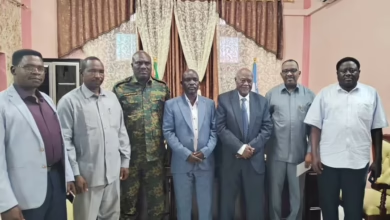
The details of the secret meeting that brought together the first team, Abdel Fattah Al -Burhan and the chief advisor of the American president, Massad Paul, in Zurich, reveals a possible transformation of the American approach to the Sudanese crisis. After a year and a half of the talks that did not obtain concrete results, this high level meeting comes to raise questions about the nature of the new American strategy and the role of the regional parties in the drawing of the course of the solution.
The confidentiality that surrounded the meeting and the lack of conscience of certain Sudanese officials have raised questions about the causes of an intense secret. Washington may be trying to open a direct channel which is directly and far from the spotlight, far from the official framework of Jeddah or Manama talks, which has not led to small solutions. This change in the approach, which indicated media sources, can be a reaction to the policies of the previous American administration, which can have complex relationships instead of facilitating them.
The message carried by Massad Paul de Washington, which confirms the desire to “establish direct relations with Sudan”, reflects an American conscience that the search for a solution to the crisis requires treating the recognized Sudanese government, represented by the Council of Sovereignty of Transition. This recognition can give the Government of proof 1 international parish and puts it in a stronger position during negotiation. On the other hand, Washington’s vintage on “democratic civil transformation” sends a clear message to its conditions of future cooperation, which complies with the requirements of the Sudanese revolution.
One of the most important characteristics of this meeting is the American position lasts at the rapid support militia. The condemnation explicit by Musaad Paul of the murder of civilians in El Fasher, the call to protect civilians and the opening of humanitarian corridors, reflects a change in American discourse. Washington abandoned his prudent diplomacy, to be accused directly at the militia. This position corresponds to what Al -Burhan revealed that the Sudanese government adheres to the need to dismantle the rapid support and the trial of its leaders, which reflects an intersection in the visions between the two parties, at least on this point.
Sources also confirm that rapid support has not been called upon to participate in these discussions, is strengthening the impression that Washington has decided to face the crisis from a purely government point of view and to marginalize the militia. This trend can indicate the possibility of an American escalation against rapid support, in particular with “intensive efforts to the American Congress to classify it as a terrorist organization”.
Although Musaad Paul stressed that the solutions should be “Sudanese pure” and that the “quartet” meetings aim to consult and not to impose solutions, this confirmation does not eliminate the pivot role played by external forces to determine the paths of the crisis. The presence of Qatari mediation in this secret meeting, in addition to the indication of the proof of “the external interference of all the parties, in particular the United Arab Emirates”, highlights the complexity of the scene.
This meeting opens the door to questions about the future of the Sudanese crisis. Will these discussions manage to pay the path of peace? Will the change in the American approach lead to different results from its predecessors? Will the next few days attend an international escalation against the quick support militia?
Hope remains required to contribute to ending civilians in Sudan, but it is necessary to be cautious, because the crisis still depends on the compatibility of the Sudanese forces and the structure of the international community to take unified and decisive positions.