
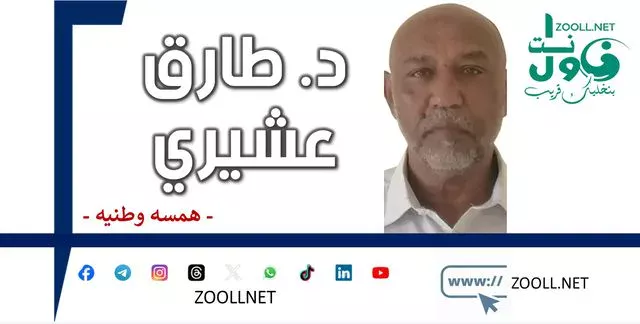
Strategic columns for the construction of the new Sudan – A National Whisper – ✍️ Dr Tariq Ashary
After years of war that ravaged Sudan, talking about reconstruction is no longer a luxury, but has rather become a fateful necessity that determines whether the country reproduces or will remain a prisoner of his injuries. But before holding the houes and building bridges and roads, we must first build the “vision bridge” which will bring us in the more stable and safe future.
The vision is not the slogans of the post -War Soudan needs a realistic, brief and inspiring vision, around which everyone wraps. This vision must determine where we want to be for a decade or two decades and be measurable, so it does not turn into words on paper, but rather plans on the ground.
Steps to make a vision
The first thing we need is a complete national dialogue in which everyone participates: politicians and intellectuals in young people in neighborhoods, the displaced in camps and farmers in the fields. Then, we strictly analyze the reality where our forces are, where our pain and the opportunities we can invest. Then, we formulate a university vision, putting a great national objective before us, and we define strategic pillars which represent our priorities.
Strategic columns for the construction of the new Sudan
Security and justice without security will not be a state, and without justice, a nation will not stabilize.
Reconstruction and infrastructure: reconstruction of roads, schools, hospitals, electricity and water.
Economy and financial stability: support for production, job creation and attract investments.
Basic services: education, health and social and social recovery for people affected by war.
National reconciliation: transitional justice, compensation for the victims and open a new page without taking revenge.
Road map
During the first two years, you must focus on stopping war permanently, the return of the move and the restart of the basic services. From the third to the fifth year, we start to projects to rekindle the economy, build housing and reform justice institutions. After that, we start the sustainable development phase: culture and industry, education and scientific research, real decentralization and balanced external relationships.
Practical steps to put the vision
1. Form a complete national committee – representing political forces, civil society institutions, local leaders, young people, women, the private sector and Sudanese communities abroad.
2. Collection of people in the field – Societal workshops in the United States, questionnaires, dialogues with people affected by war (displaced, families, return).
3. Analysis of a permanent reality (diagnosis) – Economy, infrastructure, education, short health, security, transitional justice, etc. We define strengths, weaknesses, opportunities and threats.
4. Formulate an inspiring and measurable vision – a short sentence shows where we want to be within 10 to 20 years.
5. Define strategic axes (columns) – For each column, we write measured objectives and clear initiatives.
6. Card and temporary roads of the road-priorities from 0 to 2 years (stability and resuscitation), 3-5 years (reconstruction and services), 6-15 years (sustainable development).
7. GOVERTION AND SPUTION -UP mechanisms – Implementation council, national performance indicators, transparent periodic reports, continuous participation of the community.
8. Funding and attracting the support plan – a mixture of state budget, special investments, international financing, communities transfers.
9. A national reconciliation agreement – Transitional justice, victims’ rights, community reconciliation programs.
10. A national communication plan – disseminating vision, involving citizens, awareness campaigns that strengthen confidence.
Problem indicators (examples)
The percentage of families belonging to safe accommodation within 2 years.
General unemployment rate and youth unemployment.
The percentage of access to drinking water and electricity.
The number of questions related to the violations of the war which were the subject of an investigation or the justice.
The level of growth and inflation of interior products.
Sudan is a safe, prosperous and prosperous national reconciliation – a country of chambermaid of the citizen, based on justice, education and the economic chances equal for all by 2045.
Simplified roadmap
0-2 years (stability): a permanent cease-fire, civil protection, return of the basic and restarted basic services.
3-5 years (resuscitation): housing projects, repair of water and electricity networks, urgent engines for young people, justice institutions.
6 to 15 years (development): sustainable agricultural development, investment in higher education and research, the development of export sectors, decentralization and effective municipalities.
Practical advice to succeed
Make the realistic and specified vision, not just slogans.
The involvement of people in the field increases the legitimacy of the implementation.
Connect the vision of each sector with measurable indicators and clear budgets.
Continuous communication and transparency are important to strengthen confidence
The post-war vision of Sudan is not only a political action, but rather a new social contract connecting the State and the citizen. We have to see a dream as much as you plan and inspire as much as it is implemented, a vision that says to the world: “Here is a people that has decided to transform the ashes of war into seeds of hope.” Sudan after the war is more beautiful and stronger