
Sudan: Prepare the stage of early recovery – the face of the truth – ✍️ Ibrahim Shaqlawi

With the growing indicators that reflect the approach of Sudan at the post-war stage, the role of the United Nations represented in its development program, as one of the main actors in restoration and reconstruction efforts. The arrival of program representatives in Sudan affirms the commitment of the international community to support the country at this stage, because the transition of war to peace requires an integrated strategy which includes sustainable development, reconstruction of institutions and the realization of economic stability. In this article, we are exposed to efforts to accelerate the recovery in the aspect of the efforts of the development program.
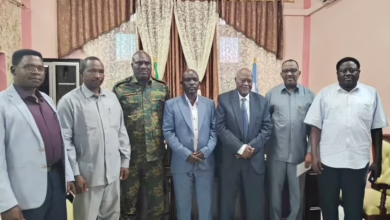
The stage confirms the start of a new phase in Sudan, where the United Nations development program “announced its arrival in the country as the first international authority to prepare to contribute to reconstruction and development efforts after the war . From his meeting to the deputy secretary -general of the United Nations, Abdullah Al -Dardari, the commitment of the Sudanese government to provide an appropriate work environment for international and regional organizations wishing to contribute to the resumption and sustainability stage for development projects social and economic.
He stressed the importance of joint coordination between the agencies of Sudan and the United Nations to effectively guarantee the implementation of development and reconstruction projects. On the other hand, Al -Dardari explained that the meeting had discussed preparations for the early recovery stage and the importance of continuing humanitarian work in parallel with development efforts, emphasizing the guarantee of Investment financing in integrated local development programs.
Sudan, as we know, occupies an advanced rank among the countries most affected by climate change according to the global adaptation initiative for the University of Notre-Dame, because it arrives in eighth place in terms of capacity to Be affected by the climate climate climate 185 countries. The deterioration of natural resources increases the difficulty of overcoming economic and social crises, which requires urgent United Nations intervention to improve the ability to adapt to environmental changes.
As part of efforts to improve risk management, Sudan has recently witnessed, according to “the flags of the Sudanese Irrigation Ministry”, the opening of the early alert room in the city of Port Sudan in the presence of the under-secretary and a number of defense leaders and civilians, with the financing of the Italian agency for development and cooperation with the “CIA” research organization. This step reflects an increasing consciousness of the need to build early alert systems to deal with climatic challenges, in particular the light of floods and dehydration. Sudan has also organized two workshops to improve national capacities in the field of early alert, in cooperation with the United Nations and specialized international organizations, in order to improve the response to disasters and ensure effective interaction between the various parties concerned.
As part of the efforts to build power, Sudan organized two previous workshops on early alert against disasters as part of the “Early warning for all” initiative, in cooperation with international agencies, including the World Meteorological Organization and the International Red Cross Federation. The first workshop focused on assessing the current situation of early alert systems in Sudan, while the second workshop focused on promoting the knowledge of dangers, with a study of flood scenarios which affected the states of Kassala, the Red Sea and Qadarfar. Participants concluded the need to improve data collection, improve prediction systems and ensure the effectiveness of communication and rapid response.
At a time when reconstruction efforts are progressing, the country faces serious political challenges, in particular the declaration of the rapid support militia and its allied political forces on the signing of a political charter in Nairobi, aimed at forming a government parallel in the areas they control.
This development has aroused warnings from the United Nations Secretary General, Antonio Guterres, who expressed a great fear that this stage would threaten the unity of Sudan and increase the fragmentation of the country, which could lead to the complexity of the crisis And to the deepening of the country’s instability, which could lead to the complexity of the crisis and to the deepening of instability. Guterres stressed that any lasting solution must respect the sovereignty of Sudan and the integrity of its land, warning that the formation of parallel governments can exacerbate the conflict and hamper peace efforts.
These developments reflect the tendency to adopt a complete vision of the reconstruction of Sudan, on the basis of three main axes, the strengthening of international partnerships, the fight against environmental and climatic crises and the improvement of the regional cooperation to ensure the sustainability of resources. As these efforts continue, the success of Sudan to cross the stability stage will depend on its ability to transform international support into concrete projects, which improves economic and social security and will establish solid foundations for permanent peace. This requires that the government institutions and the ministries concerned make fun despite the conditions of war in the speed of response to the application of these programs, and here I mean the ministry of irrigation, the ministries of infrastructure, of agriculture, social protection and the Ministry of Finance in addition to private sector institutions.
It is, according to what we see of the truth, Sudan faces a decisive moment in its history, while the country is between an opportunity for reconstruction and major political challenges after the license to modify the constitutional document for The year 2025 AD, which establishes a new stage of government. The success of Sudan to overcome its crisis depends on its ability to achieve a balance between reconstruction, the management of resources effectively and to improve political stability thanks to a complete national vision supported by sustainable international partnerships. But the question remains: can Sudan avoid the scenario of disintegration and slipping at more crises, or the management of the government in its sovereign advice capable of overcoming these challenges?
You are fine and well.
Wednesday, February 26, 2025 AD. (Protected by e-mail)