
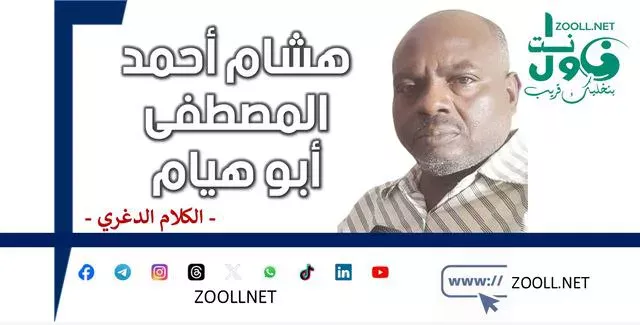
The Emirati hostile scheme for the Sudanese people: the dimensions of the intervention and the fate of the conflict – Al -Daghari – ✍️ Hisham Ahmed Al -Mustafa Abu Yamam
The introduction
In recent years, Sudanese-Emirati relations have experienced dramatic transformations, which have increased from economic cooperation and virtual human support to controversial military, security and economic interventions, which have reached the point of accusation of water to play a hostile role against the unity and stability of Sudan. With the intensification of the internal war in Sudan since April 2023, the characteristics of what many consider to be revealed by the “hostile plan” of the United Arab Emirates in order to destabilize Sudan, in preparation for the realization of strategic agendas linked to wealth, ports and regional alliances.
–
First: the context of Emirati interference in Sudanese affairs
Since the fall of the Bashir regime in April 2019, the United Arab Emirates have intensified its political and economic presence in Sudan, taking advantage of the state of political confusion which has prevailed in the transition. Abu Dhabi appeared as one of the most eminent supporters of the sovereign council at the time, in particular by providing financial support and by funding certain projects.
But under this political coverage, the United Arab Emirates began to allow local agents and to train networks of economic interests which penetrate gold, trade, transport and ports, which has created great doubts among Sudanese about its true intentions.
–
Second: military support for rapid support forces
With the outbreak of war in Sudan in April 2023 between the Sudanese armed forces led by Lieutenant -General Abdel -Fattah Al -Burhan, and the rapid support forces led by Muhammad Hamdan Daglo, “Hamidati”, the nails of the accusation directly to the water led with their direct support for rapid support forces.
United Nations reports and sources of intelligence have spoken:
Weapons shipments reach the rapid support forces by Chad and Libya.
A huge financial funding used to recruit mercenaries and buy military equipment.
Political and media support for rapid support leaders through media platforms calculated on the Emirates.
This support has strengthened the capacity of rapid support and allowed it to control large areas of the capital, Khartoum, in addition to committing horrible violations against civilians, in particular Darfur.
–
Third: Gold Conversal and Pillage of Sudanese Resources
Sudanese natural wealth, in particular gold, is one of the most important causes of external ambitions, and water have played a central role in this area. Thanks to its relations with the leaders of rapid support and some local businessmen, gold extracts facilitated control of the country and transferred it to Dubai.
International reports indicate:
Smile huge amounts of gold without going through the central bank of Sudan.
Companies owned or linked to water are involved in illegal mining activities.
The exhaustion of the Sudanese economy through commercial chaos this eagerness in the body of the exhausted state.
–
Fourth: dismantle the state and nourish the civil conflict
What increases anxiety not only the economic or military dimension, but the most dangerous aspect of the Emirati plan is to feed tribal and regional conflicts to tear the Sudanese social fabric, in particular in Darfur and Kordofan.
The qualitative support of certain militias and attempts to buy loyalty by money and arms, has helped to transform the conflict of a military confrontation with ethnic conflicts which threaten the creation of scenarios similar to what happened in Libya and Yemen.
–
Fifth: Objectives of the water to interfere it in Sudan
The body of the water is not only stemming from a desire to control or goals, but also wider strategic targets, which can be summarized in the following:
1. Hegemony on the ports of the Red Sea: the United Arab Emirates seek to weaken Sudan as a strong coastal state, to remain controlling ports such as the Sudan port or seeking to exploit it through its subsidiaries.
2. Agricultural depth in favor of Emiratic food security: because it tries to buy or control agricultural land in the absence of a strong central state.
3. He created allies affiliated to Sudan: by supporting military factions or leaders who serve their interests far from the popular will.
4. Under the Egyptian and Turkish influence in Sudan: by removing any regional force, it considers competition in the region.
–
Sixth: popular and official reactions
Despite the media failure, many Sudanese voices, whether elites or the street, began to speak publicly about the “indirect occupation” practiced by the United Arab Emirates. Popular campaigns have come out on social networks, demanding the expulsion of emiratic companies and ceasing to treat them.
At the official level, the Sudanese armed forces began to refer, and sometimes even declare, in the involvement of regional countries – in a clear reference to the Emirates – to support rebellion and chaos. Attempts to establish relations with other countries have also emerged to balance the Emirati influence, such as Türkiye and Qatar.
–
Seventh: the position of the international community and the United Nations
Until now, the United Nations has not taken a strict position on the Emirati role, although it is by stressing in international expert reports. This is due to the great financial and political influence of water to the Security Council and certain Western capitals.
But there are signs of pressure from Western human rights organizations that have started to open the Emirati intervention files in Sudan, in particular with regard to human rights violations.
–
Eighth: the future risks of the water program
If the Emirati plan continues without deterrent, the future of Sudan is threatened with several catastrophic scenarios:
A real division of Sudan in spheres of conflicting influence.
The loss of state of its strategic resources, such as gold, agriculture and ports.
Sudan has transformed into an arena of regional conflicts by proxy.
Migration and mass displacement following the climbing of war and the deepening of humanitarian crises.
–
Conclusion: Sudan is not for sale
The Sudanese people who have resisted colonialism and lowered the dictatorial regimes, will not remain silent before the regional interventions that want to flow and decompose. The Emirati scheme, although it seems to be supported by force and money, but it collides with the will of a living nation and the consciousness that grows in the Sudanese street.
Today, a unified national position is required, which is not based on political whims or temporary loyalty, but rather on the supreme interest of Sudan. The international community is also required to end sabotage interventions and support the path of peace and a democratic civil transition.
Sudan, with the history of its children and their sacrifices, is not an arena for sale or domination, but a homeland worthy of life, dignity and sovereignty.