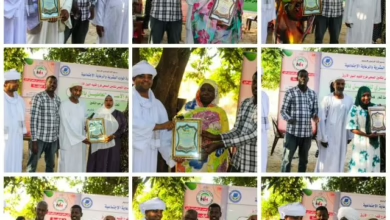

World Nubia Day: celebrate old history and civilization – something for the fatherland – ✍️ Mr. Salah Ghariba

As one of the sons of the Jaafara tribe, which shares the generous Nubian tribes, a geographical district of southern Egypt, my interest in Nubian affairs increases day by day. This interest is not limited only to geographic links, but also extends to touch my deep passion for Nubian civilization which is rooted in the roots of the history of northern Sudan, due to the practical and continuous interest in the tourism sector. Therefore, talking about International Nubia Day has many meanings and connotations that deserve meditation and celebration.
International Nubia Day is a very important annual opportunity to highlight this ancient civilization, which has not received enough chance of appreciation and attention through the ages. It is a unique opportunity to remind the world that Nubia is not only a geographical region on the banks of the Nile, but rather a cradle for a human civilization which has prospered for thousands of years, and has made great contributions to the areas of art, architecture, science and spirituality.
When we talk about Nubian civilization, we are talking about strong kingdoms such as Karma, Nabata and Marwa, who left incredible architectural and engineers who are comparable, but which have sometimes exceeded what contemporary civilizations have left them. The Nubian Pyramids of Meroe, for example, although they are smaller than the Pyramids of Giza, but they are characterized by their own uniqueness and their own beauty, and tell the stories of kings and queens which have governed this land and built a great civilization.
But the most important material effects are the inherited cultural heritage that Nubian generations inherit. The Nubian language, with its resonant vocabulary and distinctive tones, is a treasure that must be preserved and inherited. Nubian arts, singing, dance, drawing and engraving, express the spirit of an authentic people rooted in their land and their history. Nubian generosity and hospitality, the values anchored in each Nubian house, reflect the essence of this high human culture.
That day, we have to stop for a long time in front of the challenges encountered by Nubian civilization and the Nubian people, especially after the forced displacement to which they were exposed following the construction of the high dam. Nubians have lost a large part of their historical lands which included their houses, their memories and the effects of their ancestors under the waters of Lake Nasser. Despite this great test, the Nubians have risen and maintained their identity and their culture, to strike the most wonderful examples of firmness and loyalty to their origins.
Consequently, the celebration of World Nubia Day is not only the celebration of a date of the past, but rather a renewal of the alliance by preserving the rest of this great inheritance and supporting the Nubian people in their effort to preserve their identity, their language and their culture. Cultural, tourist and educational establishments must play a greater role in the introduction of Nubian civilization and its inclusion in educational programs and global tourist sites.
I hope that this international day of Nubia will be a starting point for increasingly effective efforts to support development in Nubian regions, offer better opportunities to its children and encourage cultural tourism which focuses on the highlighting of Nubian beauty and history. Maintaining a crisis is to preserve an authentic and brilliant part of the history of all humanity.

Follow us